
The adoption of AI has been extremely fast. OpenAI reached 100 million users faster than any technology in history. AI startups scale from $1M to $30M in revenue 5x faster than SaaS startups did. But why? Is AI more powerful than SaaS? Mobile? The Internet? The PC? The telephone? Raw power alone does not explain adoption speed.
Don’t get me wrong, AI is game-changing. It’s a new S-curve. It’s transformative. It’s disruptive. But make no mistake, the wave of AI we are adopting today is a veneer over a massive trove of existing technology.
You run your agent on a laptop or a server that has been iteratively improving for decades, establishing a very broad technology adoption base along the way. Prompts and LLM responses pass over a well-oiled machine of internet protocols and are presented via UI frameworks that have been reinvented and refined through the cloud era. Agents operate with well-established mechanisms like JSON to trigger agent actions, APIs to read and write data, and existing code repositories.
Maybe if and when we reach a point where AI is iterating on software without human involvement, AI will reinvent all of this to be AI native. But until then, AI builds on a deep base of technology that has been around for decades.
When I think about how quickly technologies penetrate a market, I think about adoption friction and value. I don’t include cost because cost is either part of the adoption friction if it’s prohibitive, or part of the value consideration.
Let’s take a few massive tech waves and rate them with this more nuanced perspective on adoption. Adoption speed here is admittedly a finger in the wind rather than a precise barometer reading for roughly the time from commercial availability to mainstream use. The telephone, for example, launched commercially in 1876, reached only about a third of US households by 1920, and didn’t cross half of American homes until the mid-1940s.
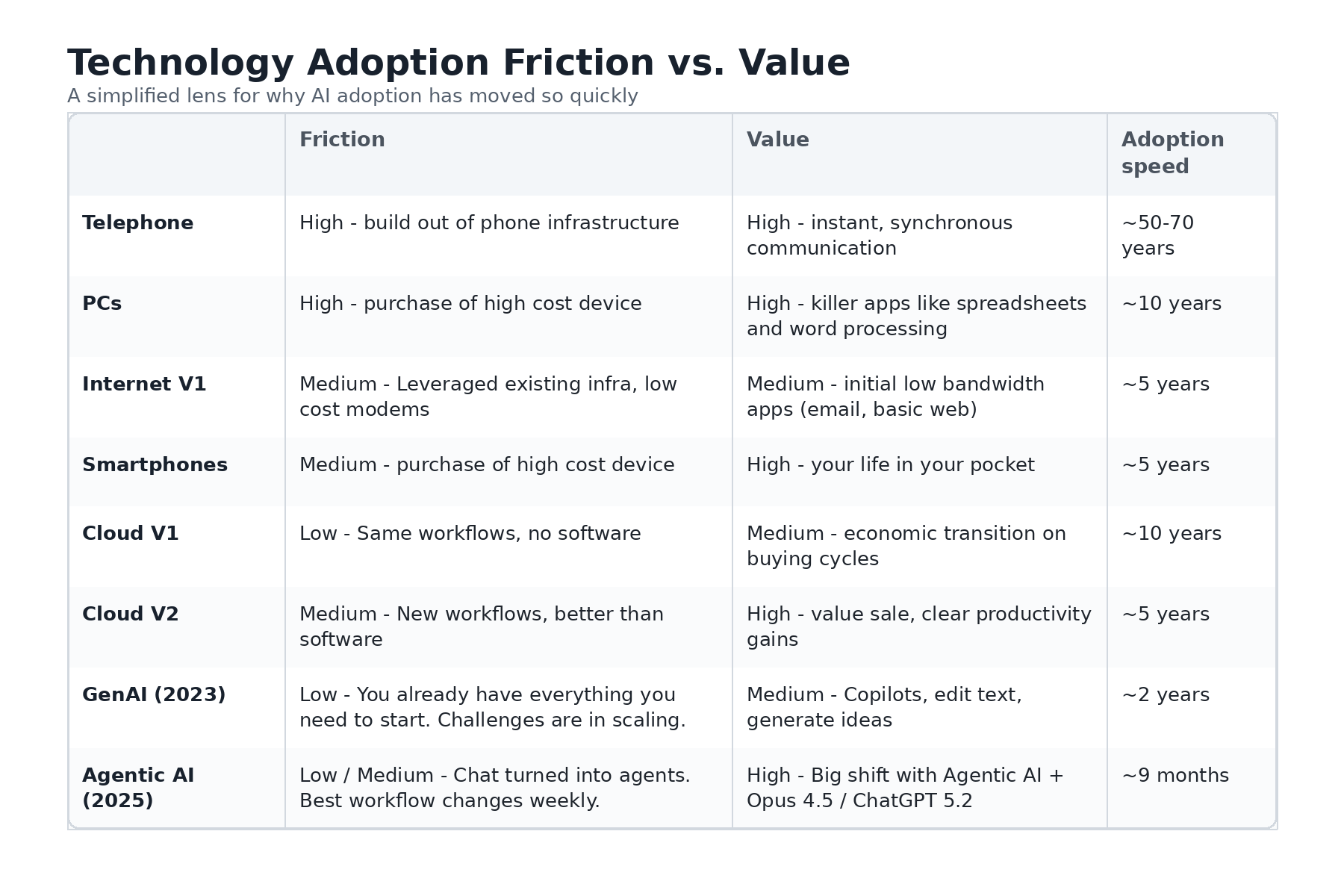
At a customer advisory board meeting in March 2026, I heard nearly unanimous adoption of Agentic AI. Claude Code was only GA in May 2025.
When you look at it from this perspective, you can clearly see there’s more going on here. Agentic AI is very powerful. That’s absolutely a big reason why we see adoption happen so quickly. But that doesn’t tell the whole story. Its game-changing value alone doesn’t fully account for the speed of adoption of agentic AI. A good amount of the adoption is due to existing familiarity with GenAI tools and APIs that have been around for a couple of years, and to the ease of getting started because of cloud, mobile, internet, and PC tech that have been developing for decades.
Now, this is not inevitable for everything new that comes to market. Blockchain is more of a mixed bag, and I’d argue that’s exactly why it has really never fully taken off the way AI has. Blockchain requires a complete rewiring of how the modern internet works. You no longer have trusted centralized systems, and instead need to rearchitect everything for the distributed blockchain model. On the consumer finance side, full adoption of cryptocurrency requires a rethinking of the banking system. It took decades just for POS systems to modernize to handle mobile wallet and tap technology. Crypto does not simply layer onto the existing banking models. That’s why it’s been limited to a speculative investment, with the hope of serving as an alternative to precious metals or cash savings.
Why is this important? Because AI is transformative, but we don’t have to be religious about it to understand why adoption took off so quickly. We don’t have to put it on such a high pedestal that we don’t consider its true pros and cons, just because we see it grow so quickly in popularity.
We will likely have AI embedded in much of the software we use. And software development, its most clearly valuable use case, has already changed forever. But let’s be clear, the stage was perfectly set. The hard job now is to focus this new tool we have on where it’s going to add the most value.