
The AI bubble is not the same as the dot-com bubble. Yes, there are surface-level similarities. There are also important differences. We can learn from history, and history does repeat itself, but the repeat is never an exact replica. Similar to the dot-com bubble, there is extremely large CapEx spend on massive infrastructure. And it’s a brand new technology that has real power for dramatic change. However, as I showed in my last article, AI is being built on top of decades of existing technology, whereas the dot-com wave was built on much more nascent technology that still had massive gaps (e.g., last-mile telecom bandwidth). Instead, I’d like to offer an alternative analogy and structure the risks rather than make a prediction.
Our current hype-driven AI bubble is fundamentally an accelerated build-out of infrastructure that is useful in a variety of ways. There is no “dark fiber” moment coming. However, not all use cases command the value required to justify the high cost of this acceleration. Yet, the players leading the build-out are well-funded, with strong primary businesses. If hurdles align to cause the AI bubble to burst, it will burst as a deterioration of business metrics and valuations, driven by increasing energy limitations, uneven ROI across use cases, and commoditization in lower layers of the stack.
The Nature of the AI Bubble
The AI build-out has some parallels with the dot-com bubble, but it’s not exactly the same. Rapid adoption this time around is real. And, while it’s getting marginally harder to secure real estate and energy for new data centers, we don’t have a fundamental hard limitation on growth that is as big of a barrier as last-mile phone lines were in 1999. The data center barriers are more nuanced, vary by region, and have more gradual limitations as an array of options exist.
The best analogy that comes to mind for me was the Motorola-led build-out of the Iridium satellite network in the 1990s. For all the talk of SpaceX’s Starlink, Motorola and its partners in Iridium were the first to conceive of, launch, and operate a network of interconnected satellites for telecommunications. It went live on November 1, 1998. The technology was truly a feat of engineering at the time. Motorola built the satellites and the satellite phone devices. Calls would route across satellites in space. Sound familiar? Keep in mind, this was 30 years before SpaceX began launching Starlink satellites.
The technology was incredibly successful. And, there were really valuable maritime and military use cases. The problem was that there were not enough high-value use cases to justify the massive CapEx investment.
Iridium filed for Chapter 11 on August 13, 1999. Motorola’s losses were massive. However, with the help of the bankruptcy court and the US government having a valuable use case, the assets were kept running by a newly reborn Iridium Satellite company. Motorola had to write off $2.5B in losses, but bankruptcy saved it from what would have been an additional $4B. In a twist of fate, New Zealand’s Rocket Lab just announced an acquisition of Iridium for $8B as the pragmatic horse in today’s satellite telecom space race. That feels small compared to today’s mega-cap companies, but fairly remarkable for a company that, at the time, felt like a complete disaster.
This was financially painful. It was a mistake that had a lasting impact on Motorola. Yet the infrastructure found an immediate use. It did not lay dormant. It was a capital investment loss by a well-funded player.
What we’re seeing with AI is an order (or two) of magnitude bigger, but it has a rough look to this. There are several hyperscalers, with much more cash, with much stronger core businesses, and much more VC and private equity capital at play. Yet similar mechanisms could play out. The special financial vehicles being created could separately file for bankruptcy protection if certain data center projects do not work out. These large entities could negotiate their way around unwinding data center obligations. Even if the data centers get built, if AI doesn’t have enough valuable use cases, they’ll still put the compute power to use.
This bubble will deflate more than burst, as a deterioration among well-funded players. It will cause valuations to go down. The ones that are the most financially vulnerable, with weaker core businesses, may be exposed entirely. Markets will correct, and we could see a “risk-off” general attitude toward tech. However, this is not the same as the dot-com bubble where scores of publicly listed startups with no revenue went to zero. This is not a case where telecom companies lay miles of fiber that goes unused. The unwinding, if it happens, is going to look different.
Let’s focus now on what could lead to the unwinding.
Increasing Energy Limitations
Over the last year, bottleneck after bottleneck for AI data centers has been found, with product prices skyrocketing along with stock values. Chips, memory, rare earths, land, now locations in space. Data centers in space will probably happen, but there are too many challenges for this to be the solution at scale.
For terrestrial data centers, the final factor here is energy. How are we going to build the power plants, grid, and interconnects at the speed desired for the data center build-out?
Power plants can take a decade to build. Wind and solar can be built much faster, but you still have fundamental challenges of locations, approvals, and the grid. Each of the other bottlenecks, while challenging to scale, is more under the control of deep-pocketed organizations. But energy crosses into the world of the ordinary. Municipalities and geography are not things easily changed by billionaires. That’s really the allure of space. Space can still be controlled. But space as a true way to scale data centers just isn’t realistic.
Energy therefore has the potential to be the “last mile” problem of this era. But what is fundamentally different is that it is being planned for in concert with the data center build-out. No hyperscaler is going to build and complete a data center without accounting for the energy requirements. This is in stark contrast to laying fiber at such extreme bandwidth compared to the last-mile connections that could absorb that bandwidth.
Therefore, energy will be a true limitation. Either through skyrocketing prices, causing the final piece of the data center stack to make the whole thing far too costly, or as simply a final barrier that leads to the CapEx commitments being wound down.
Uneven ROI across use cases
Anyone who has spent significant time working with AI knows it is very spikey. We know it’s great at coding, but not great at figuring out what to build. We know it’s great at ideating, but pretty terrible at judgment. Maybe these things get better with more sophisticated models that can handle more context that comes from more sources, allowing AI over time to truly gain the human experience. Or maybe not. Or, maybe it does, but it takes 50 more years for that to happen.
Bill Gates is often quoted for having said that we often overestimate what we can do in 1 year but underestimate the progress over 10 years. While that’s true when it comes to underestimating the value of small compounding improvements, I think it’s wrong when it comes to long-term predictions of progress. The year 1984 looked nothing like the book 1984. The year 2015 looked nothing like what Back to the Future predicted for 2015. And, I don’t think 2030 will look quite like what we’re predicting it will look like with AI. We might underestimate compounding gains, but we vastly overestimate the long-term speed of breakthrough innovation or human change.
The likely path of AI is one that follows the path of past great technologies: that it has phenomenal ROI in some subset of domains. If that’s the case, we are grossly overbuilding.
As we found with internet businesses, the economics finally made sense when infrastructure got cheap. $100/mo for 1 GB broadband. Not $10k/mo for a T1 line. But this curve will be a lot smoother for AI than in the dot-com era. We can do a lot with AI right now. We don’t have to wait until we have an equivalent broadband moment.
So, we have a scenario of lumpy ROI, but a smooth curve in the decrease in value across use cases. Sky-high expectations will be hard to meet, but we’ll find lots of uses for AI at lower costs.
Commoditization
The biggest reason for some choppiness in AI valuations right now is the commoditization risk, particularly from Chinese labs and open-weight models. But there are two important variables here I want to define.
It’s becoming increasingly clear that there are many use cases where running an open weight model can be much cheaper on cloud infrastructure. From AI apps like Cursor to larger tech companies like Airbnb, they are finding cost savings by using open-weight models. This commoditizes the LLM layer, but it still requires data center spend. Frontier labs has built into the AI Harness layer to become your management layer for AI, which is stickier and allows them to gain margin. This will face competition from LLM-neutral providers or proprietary harnesses, and LLM routing becomes more popular.
Next, frontier labs, particularly Chinese ones, are working on more efficient models. This decreases demand for cloud compute, putting pressure on the demand side at the infrastructure layer.
Finally, as we continue to see efficiency gains, there is no reason why we wouldn’t see more apps that rely on inference on local devices. Some hybrid approaches are already emerging. This further takes demand away from infrastructure.
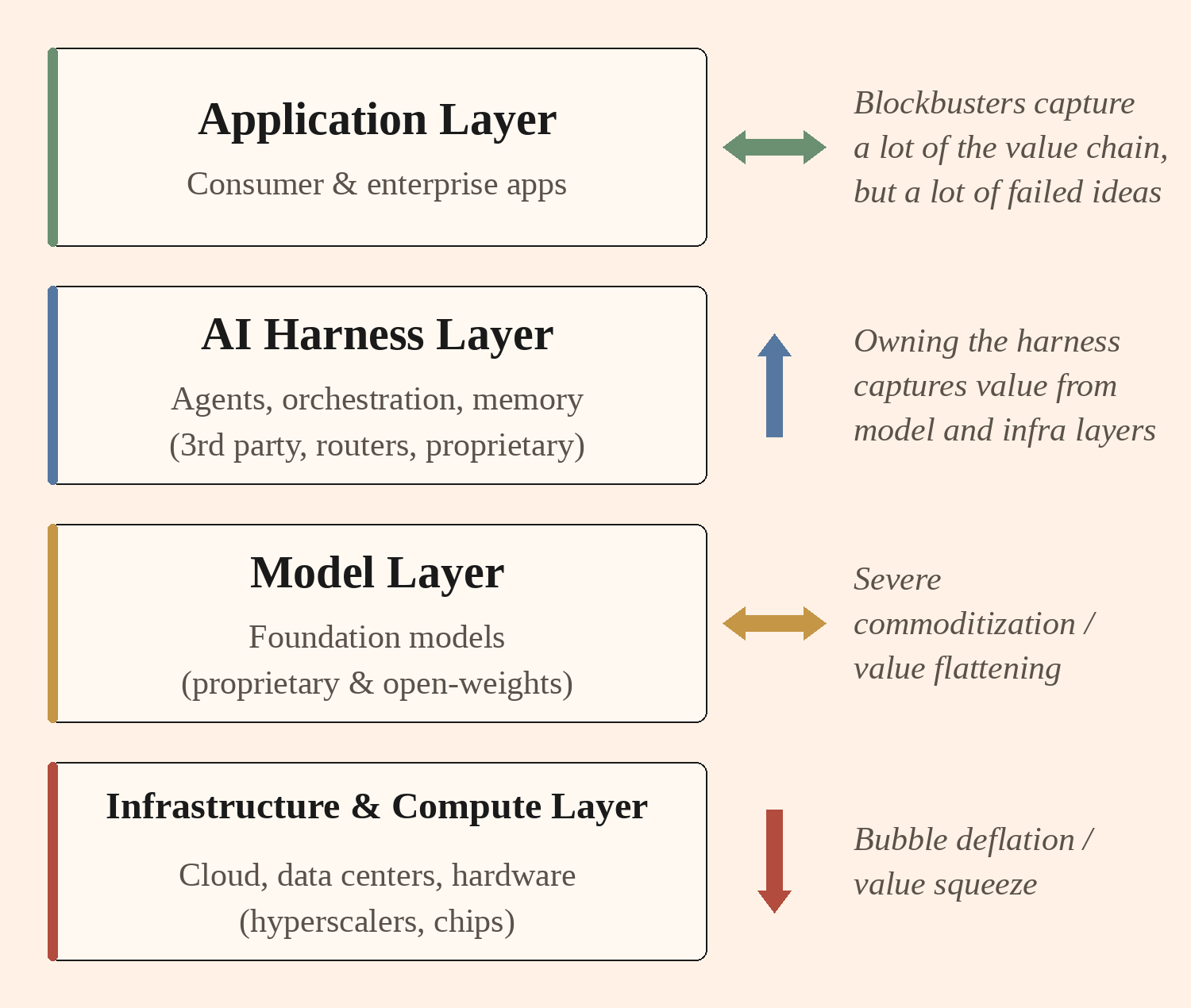
When you combine these variables, you see a picture where the entire bottom of the AI stack, which has become quite inflated, could easily deflate, even as AI usage and use cases skyrocket. In this scenario, AI itself continues to grow linearly or exponentially, but we still see a bursting bubble in infrastructure and inference.
This is not unlike most technologies. As shown in Figure 1, infrastructure becomes a cost-plus type business model over time, where low-cost providers prevail. High margins and value accrue to players who control the experience, either for builders or for users.
Conclusion
It is becoming obvious that we are in an AI bubble. While all bubbles happen due to over-investment in something good, no bubble pops in the same way. While feeling like an echo of the dot-com era, the AI bubble is very different in the maturity of underlying technology assets, strength of backing businesses, and breadth of use cases. AI is more likely to deflate based on how we see things progress with energy for data centers, the ROI of use cases, and commoditization. The most plausible AI bust is therefore not a story in which artificial intelligence fails. It is a story in which AI succeeds, usage explodes, and the infrastructure built to serve it earns far less than investors expected. Iridium did not fail because the satellites did nothing. It failed because technological achievement and investment return turned out to be very different things.
How this plays out across the economy is anyone’s guess. We’ve never had a bubble that started with layoffs. Maybe we’ll see the inverse, and the bubble bursting might actually drive higher employment. Also a factor, private financing structures could amplify losses, although there is currently little evidence of the kind of broadly distributed, mispriced leverage that turned the housing bust into the 2008 financial crisis.
There is no doubt AI is transformative. There are certainly going to be a wide array of new business opportunities that leverage AI. It has already become an integral part of our lives. But take every extreme statement about it with a grain of salt. There’s usually an underlying interest. If you dig a bit deeper, you can see some of the excesses, but you can also see that this is a vast new technology that has the potential to make software work much, much better than ever before. That’s ultimately where its power is going to be.
You mention multiple hyperscalers with strong businesses. These are companies that are monopolies. Total monopolies in their space. And they think they are at existential threat if they don’t participate in the space race.